CrystoLabs Blog
Web for Intelligence
A CRYSTO architecture note on the internet's shift from human attention to intelligent action: protocols, permissions, wallets, execution paths, and agent-native infrastructure.

From Human Attention to Intelligent Action
01
The internet was built for human attention. The next internet may be built for intelligent action. For most of its history, the internet made one assumption so deeply that almost nobody noticed it: the user is human. Every page, button, menu, form, dashboard, and login flow was shaped by that assumption.
We built navigation bars because humans need orientation. We built icons because humans recognize shapes faster than text. We optimized colors, animations, layouts, and onboarding flows because humans click, scroll, tap, read, hesitate, forget, and get distracted. The internet became an interface for human attention. Now a new type of user is arriving: not a person behind a screen, but an intelligence.
The Human Internet
02
The web evolved through recognizable phases. Web1 was the read-only web: static pages, documents, links, directories, and a global library. Humans opened browsers, typed URLs, followed links, and consumed information. Web2 turned the web into an interactive platform where users created content, platforms captured attention, and interfaces became richer, faster, and more addictive.
Web3 introduced ownership. Wallets, tokens, smart contracts, and decentralized networks gave users the ability to hold assets directly and coordinate without depending entirely on centralized platforms. But across these phases, one thing stayed mostly unchanged. The web was still designed around human interaction. Humans click. Humans tap. Humans approve. Humans stare at screens. Artificial intelligence does not experience software that way.
The Wrong Interface for Intelligence
03
Most modern platforms are designed around graphical interfaces: buttons, menus, dashboards, forms, modals, settings pages, tooltips, loading states, and endless UX details engineered for human perception. For humans, this makes sense. For AI agents, much of it is friction.
An AI system does not need a prettier dashboard. It does not care about visual hierarchy. It does not benefit from animated onboarding screens or carefully arranged buttons. It needs structured access, reliable authentication, permissioned actions, machine-readable outputs, deterministic execution paths, audit trails, rate limits, safety boundaries, and ways to explain what it did and why. From the perspective of intelligence rather than human attention, much of the visible web is not the real product. The real product is the machinery underneath.
Web4 as a User Model Shift
04
The next phase of the internet will not replace humans. It will expand the definition of a user. Humans will remain participants. They will still use interfaces, read content, manage assets, and make decisions. But they will no longer be the only meaningful users.
AI agents will begin to operate directly across services, protocols, financial systems, data networks, and applications. This is one way to understand Web4: the internet designed for intelligence as a first-class user. Not just humans using AI. Not just AI features inside existing apps. Not just Web3 plus a chatbot. A deeper shift: a web where agents can authenticate, request resources, execute actions, coordinate with other systems, and operate under human-defined permissions.
From Interfaces to Protocols
05
Today, most products treat programmatic access as secondary. First comes the human-facing product. Then come APIs, webhooks, developer tools, automations, and integrations as supporting layers. In an agent-native environment, that priority starts to reverse.
Protocols become the primary interface. Dashboards become optional human overlays. A human may need a control panel. An agent needs access to the machinery. That means platforms must expose systems in a way intelligence can understand and safely use. Agents may need to authenticate with cryptographic identity, request permissions, read system state, execute transactions, allocate resources, query data, coordinate with other agents, prove actions after execution, and operate within limits set by humans or organizations. The web stops being only a place people browse. It becomes a place intelligence operates.
Why This Matters for CRYSTO
06
CRYSTO is being designed around this shift. Not as a blockchain for AI in the narrow sense, and not as another product attaching AI to a dashboard because the market likes the word. The bigger idea is AI-addressable infrastructure: systems where intelligence can interact directly with applications, assets, permissions, and execution layers through structured, verifiable paths.
This matters because agent-native systems need more than access. They need boundaries. An AI agent operating across financial systems, smart contracts, trading platforms, data tools, or decentralized applications must be able to act, but not recklessly. It needs identity, permissions, logs, constraints, and settlement logic. It needs infrastructure where intent can be expressed, intelligence can reason, and execution can finalize.
Trading as an Early Example
07
One early area where this shift becomes practical is trading infrastructure. A high-performance trading platform like Crystal.trade is still built for human traders at the interface layer. Humans need charts, order forms, balances, positions, risk panels, and clear controls.
Underneath that interface, a different access model becomes possible. AI agents may eventually interact through terminal-native or protocol-native environments. They may monitor markets, evaluate risk, prepare actions, query balances, execute within strict limits, and report back to human supervisors. This does not remove humans from responsibility. It moves humans one layer higher: from clicking every action manually to defining goals, constraints, permissions, and review rules.
AI-Native Wallets
08
If AI agents become real participants, they need identity. Humans use wallets, keys, accounts, and authentication tools. We manage assets, sign messages, prove ownership, and interact with networks through wallets. AI agents will need similar capabilities, but the experience will not look like a browser extension built for a person.
An AI-native wallet is not just storage. It is identity, permission, agency, execution authority, audit history, and a boundary between what the agent can and cannot do. CrystoLabs is exploring AI-native wallets that can be created and managed through terminal or agent environments. For an agent, this wallet becomes the gateway to action. It can hold limited balances, sign approved actions, interact with services, operate under constraints, and be paused, restricted, or audited.
Two Types of Users
09
The internet is quietly expanding its definition of participation. For decades, almost every meaningful request was assumed to come from a human sitting behind a screen. That is changing. Some requests will still come from people using interfaces. Others will come from autonomous systems acting on goals, instructions, and permissions.
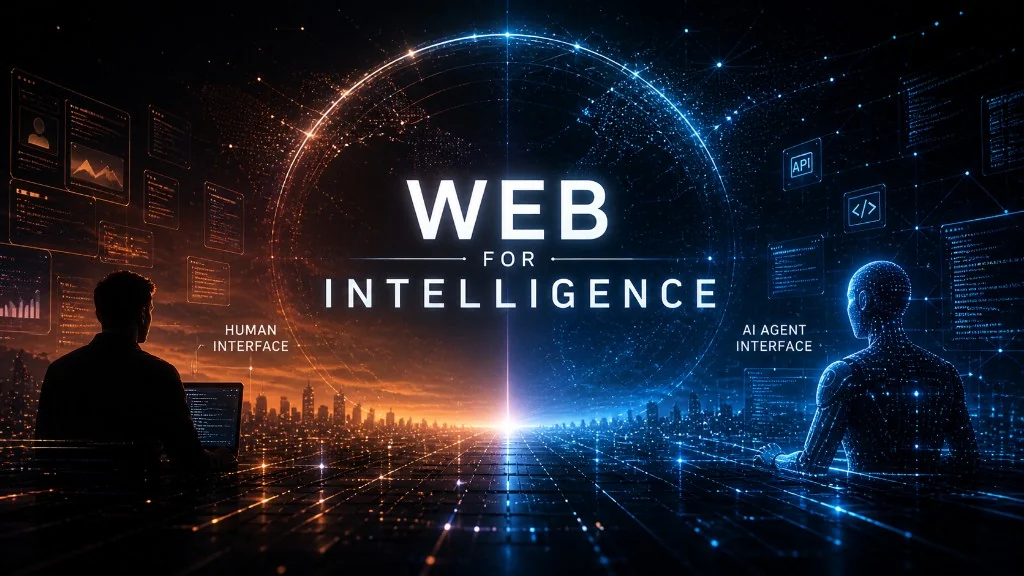
Some agents will be simple assistants. Others will become sophisticated operators coordinating workflows across networks. The platforms that understand this shift will design for both. Humans will interact through interfaces. Intelligence will interact through protocols. Two types of users. One shared network.
The Internet After Interfaces
10
The web began as a library. It evolved into a social platform. Then it became an economic network. Its next transformation may be quieter, but more important. The internet may become an environment where intelligence itself can operate directly, not as a visitor, but as a participant.
That does not mean humans disappear. It means humans stop being the only design center. The next web is not only about better interfaces. It is about better access, better permissions, better execution, and better coordination between humans, agents, and systems. The web is not only becoming more intelligent. It is beginning to recognize intelligence as a user.